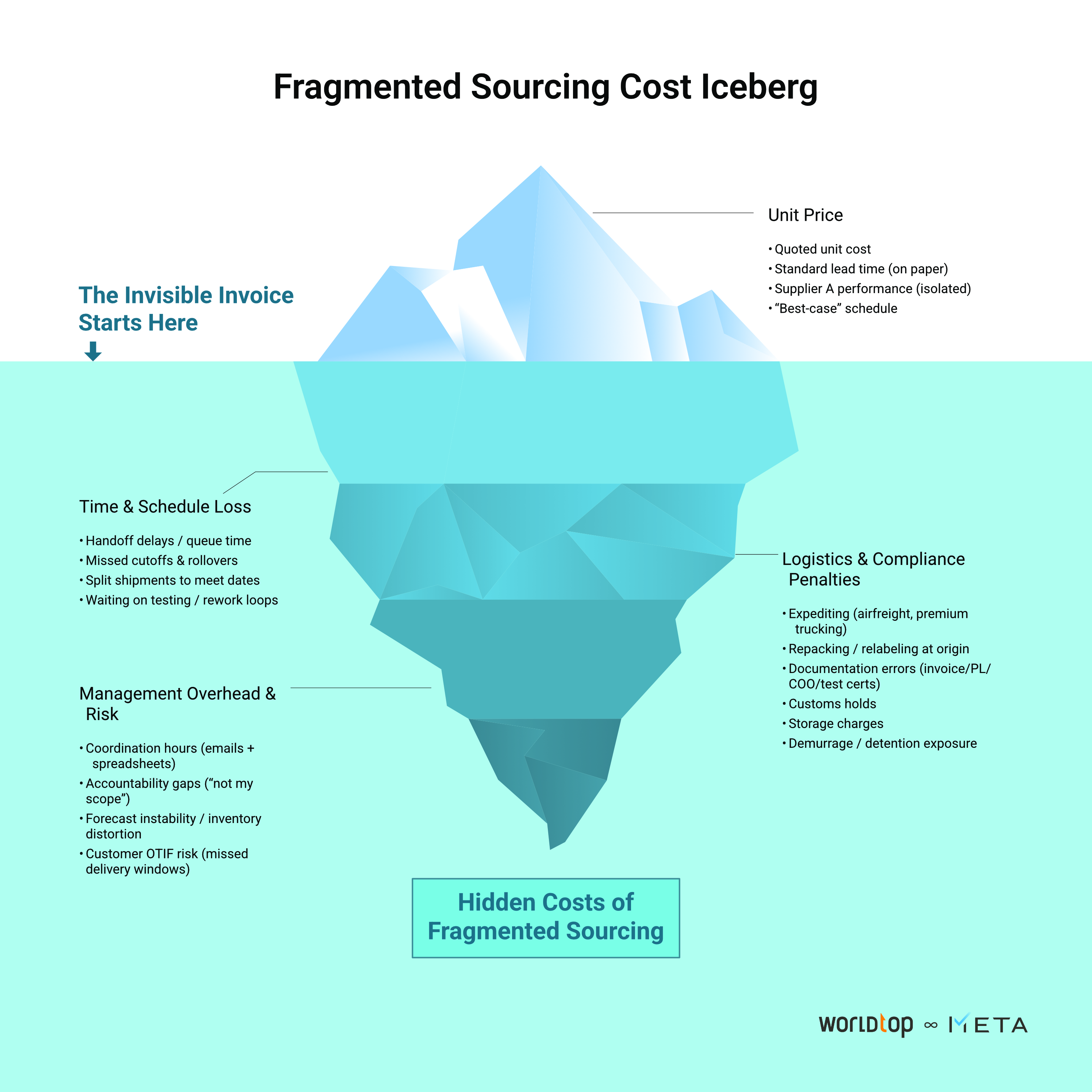
Most cross-border partnerships do not fail because of one dramatic mistake. They fail because one side evaluates only the visible layer— price, samples, responsiveness, or sales potential — while the harder execution risks stay hidden until after the first PO. North American and European buyers need better ways to assess East Asian suppliers, and East Asian suppliers need better ways to assess Western buyers before reserving capacity. The real job is not just finding a partner. It is choosing one that can actually execute under pressure.
In international trade, both sides often believe they are doing due diligence.
The buyer compares suppliers, requests quotes, reviews samples, and chooses the most attractive option.
The supplier evaluates the opportunity, reviews the forecast, and decides whether the account looks worth pursuing.
But in many cross-border relationships, that evaluation is still incomplete.
Buyers often focus on whether the supplier can make the product. Suppliers often focus on whether the buyer can place the order. What both sides should really be asking is something more operational:
Can the other side execute reliably once payment terms, compliance demands, approvals, logistics, and change requests become real?
That is where many promising partnerships begin to break down.
Many SMB sourcing workflows are built for discovery, not deliverability. They surface names and quotes, but do not reliably validate export readiness, execution consistency, downside risk, or recovery pathways before commitment.
On the other hand, factories often discover too late that buyer immaturity turns into supplier cost through late approvals, vague specs, payment delays, compliance surprises, and logistics disputes.
This article combines both perspectives into one practical framework.
A cross-border transaction is not only a product decision. It is a coordination decision.
The supplier may be capable. The buyer may be legitimate. The quoted price may be workable. But if the relationship cannot hold up under real operating conditions, the hidden cost appears later in the form of:
That is why the best partnerships are not created by attractive quotes or polished presentations. They are built when both sides are operationally executable.
Traditional sourcing advice usually teaches the buyer how to choose a supplier.
Factory-side advice usually teaches the supplier how to screen a buyer.
Both are useful, but both are incomplete on their own.
A more durable approach is to treat the first transaction as a mutual due diligence exercise. That means:
This is the missing middle in many international trade relationships.
Below is the most practical way to compare the two sides before the first PO.
This comparison matters because the failure pattern is often symmetrical. When either side is weak in one of these areas, the burden usually spills into production, freight, or dispute handling later.
For buyers, this means asking whether the supplier can explain lead times, capacity assumptions, quality controls, and escalation paths clearly.
For suppliers, this means asking whether the buyer can explain forecast logic, decision ownership, order cadence, and how change requests are handled.
A polished presentation is not enough. A credible partner can describe how decisions are actually made.
One of the clearest warnings from the factory-side source article is that buyers can look commercially promising while still being financially unstable. Long payment terms, no deposit on the first PO, or dispute-driven payment delays are not minor issues. They are structural risk signals.
The buyer-side equivalent is just as important. A low quote does not mean low total cost. Once expediting, retesting, split shipments, or delay recovery enters the picture, the original unit price becomes much less meaningful. The source draft on sourcing makes this point clearly through the idea that the quote is only the visible tip, not the full cost.
Compliance should not be treated as a late-stage detail.
Buyers need to know whether suppliers can support the documentation, labeling, traceability, and category-specific requirements needed for North America or Europe. Suppliers need to know whether the buyer actually understands those requirements and has internal ownership for them.
A common failure pattern is simple:
That is not just a compliance problem. It is a partnership-fit problem. Both source articles emphasize this from opposite ends.
The Hidden Costs of Fragmented Sourcing: Every Handoff Adds Risk, Delay, and Cost
Choosing a Taiwan Shipping Partner: 5 Criteria for EU & North American Businesses
Many disputes that look like manufacturing problems are actually logistics responsibility problems.
If Incoterms are vague, carton rules are unclear, booking responsibility is undefined, or document flow is inconsistent, the relationship becomes expensive very quickly. The factory-side article explicitly notes that many cross-border disputes are not manufacturing failures but logistics and responsibility failures. The sourcing-side article frames the same issue as part of “trade-side discipline,” including routing reliability, documentation competence, and tariff exposure awareness.
Before the first PO, both sides should be aligned on:
This is one of the most overlooked areas.
Factories often assume quality issues come from production. Buyers often assume supplier inconsistency is the main problem. In reality, many failures begin upstream with unstable revisions, vague acceptance criteria, rushed approvals, and uncontrolled change requests.
A strong partnership has:
Without that structure, both sides end up arguing over issues that should have been prevented earlier.
On the buyer side, the visible layer is the quote, the sample, and the factory presentation. Below the waterline are the hidden costs: coordination time, rework, queue delays, compliance surprises, missed cutoffs, and the recovery tax of rush + air + redo.
On the supplier side, the visible layer is the polished buyer —website, forecast, urgency, brand deck. Below the waterline are payment behavior, documentation discipline, approval speed, Incoterms clarity, and whether the buyer truly understands cross-border execution.
The lesson is the same for both:
The visible part of the opportunity is usually not what determines whether the relationship is profitable.
Before the first PO, both sides should score the other on five dimensions:
If two or more of these areas are weak before the first PO, the partnership is likely to become expensive later.
Another strong operational takeaway from the factory-side article is the idea of a lightweight 72-hour onboarding process followed by a controlled pilot PO. That includes:
That idea is useful not only for factories, but for buyers too.
The first PO should not be treated as proof of long-term fit. It should be treated as a live test of how both sides handle real execution.
The factory-side draft makes a useful distinction: North American buyers often operate with faster commercialization cycles and stronger speed pressure, while European buyers often bring heavier documentation and compliance expectations.
That does not mean businesses should stereotype markets. It means they should plan for different operating realities.
Likewise, buyers sourcing in East Asia should not rely on country-level narratives alone. The sourcing-side article argues for moving from “factory-first” searching to country-plus-factory decisioning, where businesses weigh tariff exposure, risk, ESG expectations, manufacturing value, and trade-offs under their own constraints.
The most practical takeaway is simple:
Do not choose based on who sounds good. Choose based on who fits your actual operating model.
Cross-border trade works best when both sides stop thinking one-dimensionally.
Buyers should stop asking only, “Can this supplier make the product?”
Suppliers should stop asking only, “Can this buyer place the order?”
Both sides should ask:
Can this partner execute consistently when payment, compliance, logistics, approvals, and time pressure all become real at once?
That is what partnership fit really means.
And in cross-border trade, partnership fit is what protects timelines, cost, margin, and trust.
It is the degree to which both sides can work together reliably across payment, compliance, logistics, approvals, and change management — not just whether they can agree on price.
Because it usually exposes the real operating behavior of both sides. That is why the first order should be treated as a controlled pilot, not automatic proof of long-term fit.
Usually not just the quoted price. More often it is unclear ownership, unstable specs, payment friction, documentation gaps, rushed changes, and recovery actions such as expediting or rework.
Create a simple pre-PO scorecard and use it on both sides of the relationship before capacity is reserved or major commitments are made.
Need a more executable cross-border workflow?
Worldtop & Meta helps businesses reduce avoidable risk across freight, documentation, and international supply chain coordination.